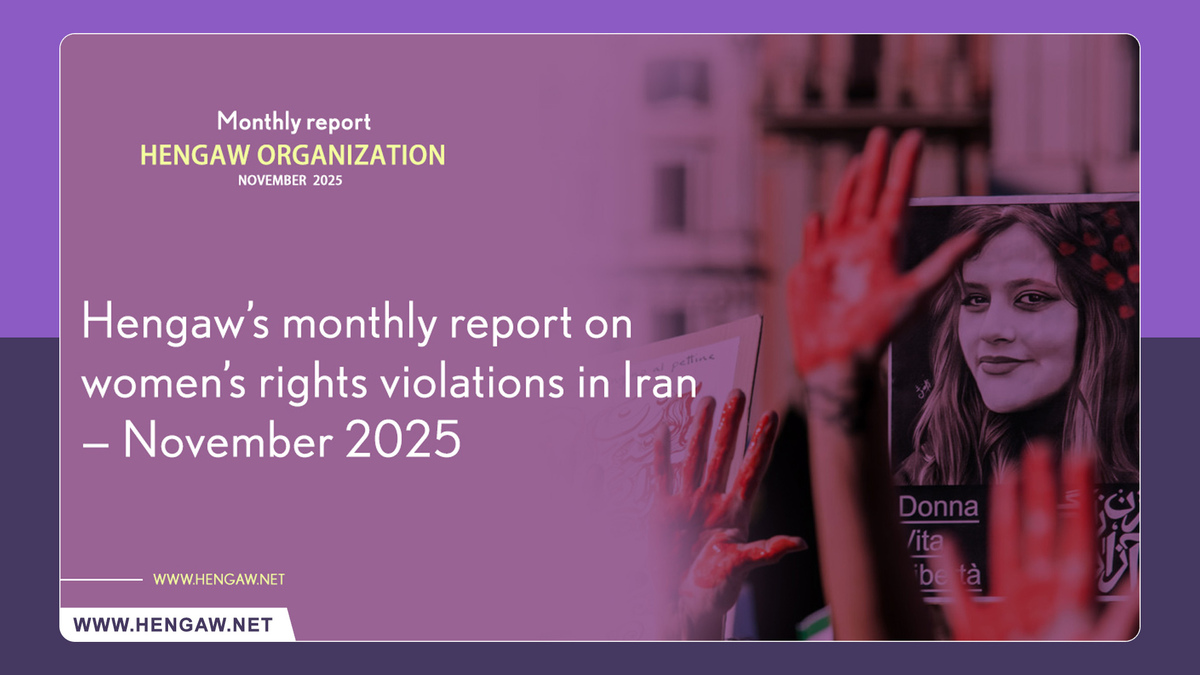
Hengaw’s monthly report on women’s rights violations in Iran — November 2025
Hengaw – Sunday, December 7 2025
According to data recorded by the Statistics and Documentation Center of the Hengaw Human Rights Organization, at least 22 women activists were arrested and five others were sentenced to prison by Iran’s judiciary during November 2025. Additionally at least 20 femicides and five executions of women were recorded across the country during the same period.
Executions of women in Iran
In November 2025, Iranian authorities carried out the executions of at least five women in various prisons nationwide. Two were executed on murder-related charges and three on drug-related charges. Their names are listed below:
1. Zahra Mirghafari from Hashtrud – executed on drug-related charges in Tabriz Central Prison.
2. Shoket Veisi from Damghan – executed on drug-related charges in Damghan Central Prison.
3. Qamari Abbaszadeh from Sari – executed on murder charges in Sari Central Prison.
4. Mahin Rahimi from Mashhad – executed on murder charges in Mashhad Central Prison.
5. Mina Sadoqi from Karaj – executed on drug-related charges in Shiraz Central Prison.
22 women activists arrested in November 2025
Hengaw’s statistics show that at least 22 women activists were detained by Iranian security agencies in November, representing 19% of all arrests recorded that month.
Among those detained were eight Baha’í women and two Kurdish women. The detainees are:
Tehran:
1. Mahsa Asadollahnejad
2. Shirin Karimi
3. Hanieh Shariati Roodposhti
4. Aferin Mohajer
5. Parya Marandez
6. Setareh Pessian
7. Sahar Dolatshahi
Karaj:
8. Mona Zakaei
9. Naghmeh Mirza Agha
10. Mahin Sa’adatmand
11. Mahshid Safidi
12. Samar Masoudi
Shahin Shahr:
13. Maryam Abbasi Nikoo
14. Beeta Shafiei
Shiraz:
15. Leila Adalati
16. Milan Khajeh’i
Ahvaz:
17. Maryam Zubaidi
Kamyaran:
18. Sheida Azizi
Maneh & Samalqan:
19. Asmar Hamidi
Sabzevar:
20. Shokouh Sadidi
Nur:
21. Soheila Beikdelou
Gorgan:
22. Azadeh Yaghini
Prison sentences issued for women activists
In November 2025, Iranian courts sentenced five women activists to a combined 13 years, 3 months, and 1 day in prison. Their names and sentences are as follows:
1. Mehnoosh Rezaei from Shiraz – 9 years in prison
2. Zeinab Mousavi from Tehran – 6 months in prison
3. Sheida Azizi from Kamyaran – 3 years in prison
4. Nirvana Torbati-Nejad from Gorgan – 6 months in prison
5. Fa’ezeh Hassanzadeh from Kashan – 3 months and 1 day in prison
The arrest and sentencing of women remain part of a systemic pattern of gender-based repression in the Islamic Republic of Iran.
During the “Woman, Life, Freedom” uprising, pressure and prosecution against women activists intensified significantly. Since its establishment, the Iranian state has pursued institutionalized efforts to restrict women’s participation in social, political, and human rights activities.
Policies of gender segregation, the marginalization of sexual and gender minorities, and the criminalization of identity form the foundations of the gender apartheid system in Iran.
Twenty cases of femicide recorded in November 2025
Hengaw recorded at least 20 femicides across Iran in November. The vast majority of victims were killed by close family members, most commonly by their husbands.
According to the report:
• 7 women were killed by their husbands
• 2 by their brothers
• 2 by their sons
• 2 by sons-in-law
• 2 by brothers-in-law
• 1 by her mother-in-law
• In 4 cases, the perpetrator’s relationship with the victim remains unknown
Among the 20 cases, one femicide was linked to so-called “honor” motives.
Additionally:
• 13 women were killed due to family disputes
• 1 woman for requesting a divorce
• 2 women for rejecting marriage proposals
• 4 women were killed with financial or theft-related motives
Breakdown by Province:
• West Azerbaijan (Urmia): 6 cases
• Sistan and Baluchestan & Tehran: 3 cases each
• Kerman & Gilan: 2 cases each
• East Azerbaijan, Hormozgan, Yazd & Fars: 1 case each
Femicide represents the most extreme form of misogyny and gender-based violence in society. So-called honor killings account for only part of these crimes; their root lies in deeply patriarchal social structures and discriminatory laws.
According to Hengaw’s reports, 191 cases of femicide were documented across Iran in the past year alone, the majority committed by close family members.
Misogynistic laws and state ideologies have normalized violence and hatred against women, embedding discrimination into the legal system itself.
Hengaw Organization for Human Rights classifies the Islamic Republic of Iran as a gender apartheid state, in which systematic violence and killing of women have been institutionalized and legally protected.
The organization calls on the international community to recognize Iran’s gender apartheid system as a crime against humanity, and to take concrete action to hold the Islamic Republic of Iran accountable for its entrenched, state-sponsored discrimination against women.