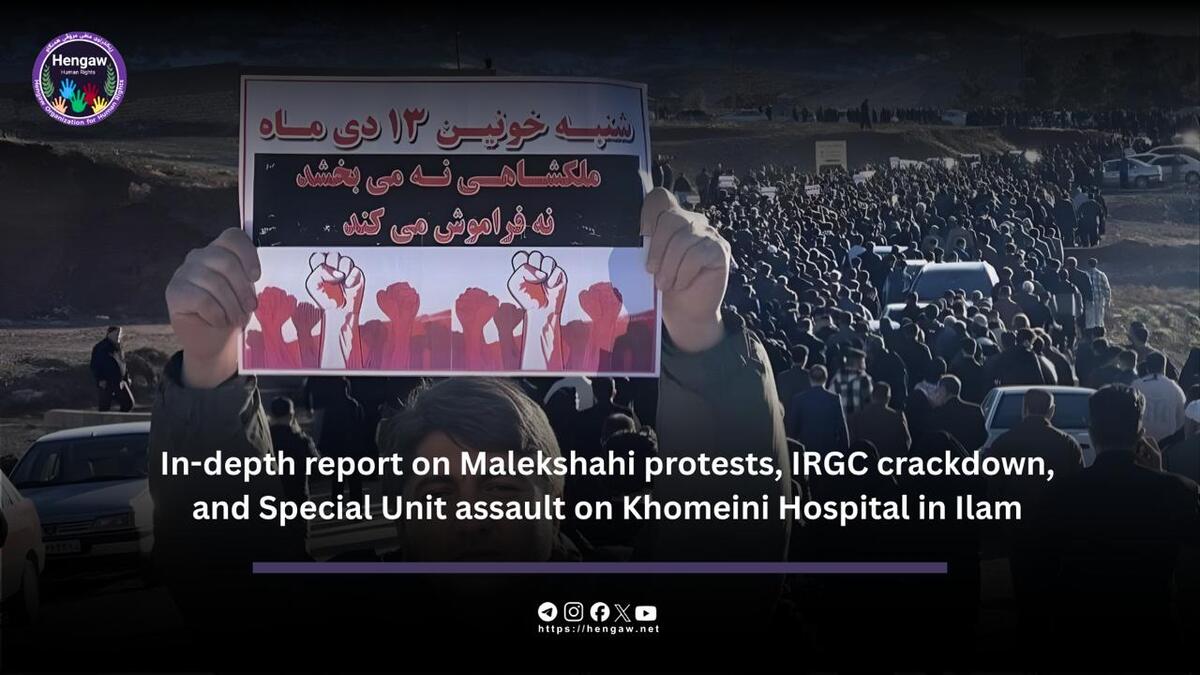
In-depth report on Malekshahi protests, IRGC crackdown, and Special Unit assault on Khomeini Hospital in Ilam
Hengaw – Tuesday, January 6, 2026
Hengaw Organization for Human Rights has released a detailed report on the situation following the violent suppression of public protests in Malekshahi County, Ilam province.
Hengaw stresses that the actions carried out by the Islamic Republic of Iran—particularly those unfolding in Malekshahi and at Khomeini Hospital in Ilam—constitute serious violations of the right to life and the right to peaceful assembly, while also breaching the protected status of hospitals and endangering the lives of the wounded.
Recent protests in Ilam province, especially in Malekshahi County, were met with violent force and widespread repression by Iranian authorities. The use of live fire against unarmed protesters, the killing of civilians, the injury of dozens of people, mass arrests, the attack on a hospital treating the wounded, and the hospital’s siege for more than 24 hours together indicate extensive and systematic human-rights violations.
تصاویری از رگبار مستقیم و هدفمند نیروهای سپاه پاسداران بە داخل جمعیت معترض در ملکشاهی ایلام
— Hengaw Organization for Human Rights (@HengawO) January 4, 2026
در این ویدیو بە وضوح لحظه اصابت گلولە بە مهدی امامیپور دیدە میشود.
شنبه ۱۳ دی ۱٤٠٤ pic.twitter.com/H3Twh7B01s
Public protests in Malekshahi began on Saturday, January 3, 2026, in response to economic crises, unemployment, and severe livelihood insecurity. The gatherings were entirely peaceful. However, forces stationed at an Islamic Revolutionary Guard Corps base inside a Basij building located on Farmandari (Governor’s office) Street responded with extreme violence. Shortly after people gathered outside the building, these forces opened sustained gunfire toward the crowd, injuring a number of protesters. Several of those wounded later died before reaching Khomeini Hospital in Ilam.
During the same protests, gunfire was directed at the crowd from very close range and from the rooftop of the Basij building. Hengaw has verified the identities of at least five individuals killed: Mehdi Emamipour, Reza Azimzadeh, Farez Aghamohammadi, Mohammadreza Karami, and Latif Karimi.
بر طبق ویدیویی کە از اعتراضات ملکشاهی بە دست هەنگاو رسیدە بە وضوح نشان میدهد، نیروهای سپاه پاسداران مستقر در جلوی پایگاه بسیج سپاه پاسداران ایران، با سلاحهای جنگی در مقابل جمعیت معترضان ملکشاهی در جلوی ورودی این پایگاه مستقر شدەاند و بە طور رگباری مبادرت بە تیراندازی میکنند.… pic.twitter.com/2PfEBlntgW
— Hengaw Organization for Human Rights (@HengawO) January 6, 2026
In addition to those killed, more than 40 protesters were injured. Due to the lack of basic medical facilities in Malekshahi, most of the injured were transferred to Khomeini Hospital in Ilam. The condition of several of them was reported to be critical.
In the initial hours following the admission of the wounded people inside Khomeini Hospital shared videos appealing for urgent blood donations, particularly O-negative blood, due to severe shortages. Hengaw spoke with individuals who a ttempted to donate blood and confirmed that many were prevented from entering the hospital because of the heavy presence of security forces surrounding the facility. According to these accounts, security forces opened fire on civilians who had gone to the hospital to donate blood, injuring several people.
Faezeh Rashidi, 35, from Badreh, was among those injured outside the hospital and was subsequently arrested. No information about her whereabouts is currently available. Meysam Nouri, a 21-year-old from Ilam, was another injured individual who was arrested despite having sustained serious injuries, including broken wrists and teeth.
Violation of the protected status of medical facilities and attacks on hospitals
Information received by Hengaw confirms that Khomeini Hospital in Ilam became a new site of repression immediately after admitting the wounded and the deceased. More than 24 hours later, the hospital remained surrounded by government forces and was subjected to direct gunfire.
Special Unit forces in Ilam stormed the hospital grounds and attempted to enter medical wards, seeking to remove the bodies of those killed and forcibly take injured protesters out of the hospital.
In response, several members of the medical staff attempted to protect the wounded and safeguard their lives by blocking the forces’ access to hospital wards. As a result, they were subjected to beatings, verbal abuse, and threats by Special Unit forces.
فوری
— Hengaw Organization for Human Rights (@HengawO) January 4, 2026
بر اساس ویدیوهای دریافتی هەنگاو،شامگاه یکشنبە ١٤ دی ماه ١٤٠٤ نیروهای پرشمار سرکوبگر حکومتی بە بیمارستان خمینی ایلام یورش و علاوە بر محاصرە این بیمارستان، از فاصلە بسیار نزدیک و بە صورت هدفمند بە مردم حاضر در محوطە بیمارستان شلیک میکنند.
روز گذشتە پس از سرکوب خشونت آمیز… pic.twitter.com/NSTAWBb3fa
Within the hospital compound, Special Unit forces used batons, tear gas, and live ammunition, severely disrupting the safety of the medical environment. Individuals attempting to prevent their entry were targeted from very close range with military-grade weapons, while large quantities of tear gas were deployed to disperse those gathered nearby.
تصاویر دیگری از درب ورودی بیمارستان خمینی ایلام کە نشان میدهد نیروهای یگان ویژە با پرتاب همزمان چندین گاز آشک آور در تلاش برای ورود بە داخل بیمارستان بودەاند.
— Hengaw Organization for Human Rights (@HengawO) January 5, 2026
شامگاه یکشنبە ١٤ دی ماه ١٤٠٤ نیروهای پرشمار سرکوبگر حکومتی بە بیمارستان خمینی ایلام یورش و علاوە بر محاصرە این… pic.twitter.com/rQkECLCJgi
Sources inside the hospital told Hengaw that this assault placed the lives of patients unrelated to the protests—particularly those in intensive care units—at serious risk and caused major disruptions to medical treatment throughout the hospital.
In connection with these events, a large number of protesters were violently arrested by Iranian authorities in the vicinity of Khomeini Hospital. Children were among those detained. Families have so far been unable to obtain reliable information about the detainees’ whereabouts or health, a situation that constitutes a violation of due process and the fundamental rights of detainees.
On Tuesday and Wednesday, January 6 and 7, 2026, Rababeh Kamali School, located opposite Khomeini Hospital, was ordered closed. Hengaw sources stated that the closure was intended to facilitate the use of the school as a base for deploying and organizing security forces and for monitoring the hospital.
Hengaw considers the shooting of unarmed protesters to be a grave violation of the right to life. The assault on hospitals, threats against medical staff and the wounded, and the militarization of medical facilities constitute clear violations of the protected status of hospitals and medical personnel under international law. The unlawful arrests of protesters form part of a broader policy of systematic repression of civil protests.
In light of claims made by Ilam provincial officials and Iranian authorities—particularly those labeling peaceful civil action in Malekshahi as “quasi-terrorist”—Hengaw reiterates that these incidents and crimes must be documented, recorded, and pursued through legal mechanisms. Responsibility for these actions lies with the security and governing institutions of the Islamic Republic of Iran.