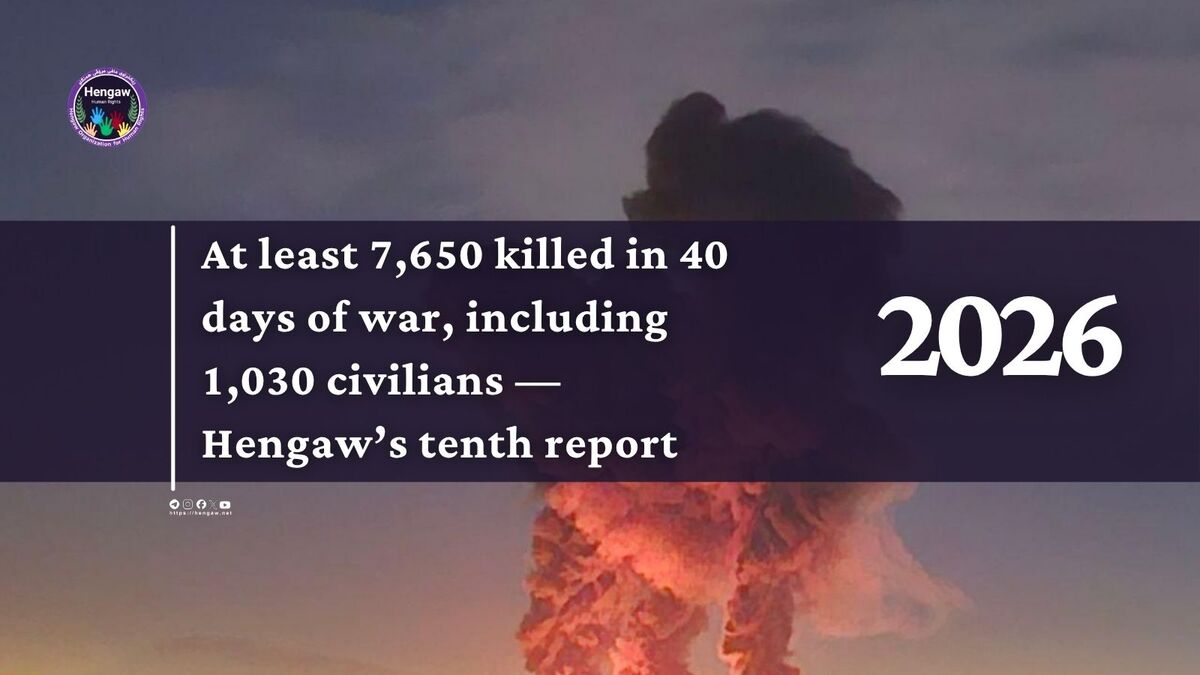
At least 7,650 killed in 40 days of war, including 1,030 civilians — Hengaw’s tenth report
Hengaw – Wednesday, April 8, 2026
With the announcement of a ceasefire coinciding with the 40th day of the Iran–United States–Israel war, the Hengaw Organization for Human Rights publishes its final report on the 40-day conflict, the last day of which lasted only a few hours before ending in a ceasefire.
According to data collected by Hengaw, at least 7,650 people were killed during the recent war, of whom 1,030 (equivalent to 13.5%) were civilians.
The war began on the morning of Saturday, February 28, 2026, with airstrikes by U.S. and Israeli forces targeting more than 10 provinces across Iran, resulting in the deaths of dozens of military and government officials, including Ali Khamenei, the Supreme Leader of the Islamic Republic of Iran. The conflict ended in the early hours of Wednesday, April 8, 2026, marking its 40th day.
At least 1,030 civilians killed
Hengaw confirms that during the 40-day conflict, at least 1,030 civilians lost their lives as a result of aerial and missile attacks carried out by U.S. and Israeli forces across various cities in Iran. This figure represents 13.5% of the total recorded casualties across the country.
Verified data confirm that among the victims were at least 189 minors and at least 215 women, highlighting the significant impact of the attacks on the civilian population.
The highest numbers of civilian casualties were recorded in the provinces of Tehran, Hormozgan, Lorestan, Alborz, Fars, and East Azerbaijan.
Following the end of the war, the identities of 48 primary school students in the city of Minab (Hormozgan Province) have been confirmed. This contrasts with earlier official claims by government authorities, which had reported 120 student fatalities at the same school.
Hengaw has repeatedly emphasized during the conflict that Iranian military forces abandoned official bases and were stationed in civilian locations, including schools, student dormitories, and mosques within residential areas. Under the Geneva Conventions, such actions constitute the use of “human shields” and place civilians at serious risk.
Casualty breakdown and geographic scope of attacks
Based on Hengaw’s field documentation, military and governmental centers affiliated with the Islamic Republic of Iran were targeted in at least 196 cities across 27 provinces during the war.
At least 6,620 military personnel were killed, the majority of whom were members of the Islamic Revolutionary Guard Corps (IRGC) and the army.
Targets included IRGC bases, Basij centers, military airports, missile sites, police stations, judicial institutions, intelligence offices, army barracks, and special unit headquarters.
The highest military casualties were recorded in the provinces of Tehran, Kermanshah, Hormozgan, Lorestan, Alborz, Khuzestan, Isfahan, Kurdistan (Sanandaj), and Sistan and Balochistan.
Hengaw emphasizes that Iranian security institutions have adopted a policy of systematic concealment, refraining from publishing accurate casualty figures and, in limited cases, releasing statistics that are significantly understated. To date, no comprehensive official report on military casualties has been issued by state authorities.
High casualties in Kurdistan and systematic concealment
According to verified findings by Hengaw, at least 290 military, security, and administrative sites in the provinces of Ilam, Kermanshah, Kurdistan (Sanandaj), and West Azerbaijan (Urmia) were targeted during the conflict.
These attacks resulted in the deaths of at least 112 civilians, including 12 children and 9 women.
In addition, at least 1,630 military and security personnel were killed in these four provinces.
Attacks on Kurdish parties’ bases in the Kurdistan Region of Iraq
According to Hengaw’s verified reports, following the outbreak of hostilities and amid speculation about possible involvement of Kurdish parties, the bases and camps of six Iranian Kurdistan parties located in the Kurdistan Region of Iraq were repeatedly targeted.
Hengaw data show that these sites were attacked at least 167 times by missile and drone strikes carried out by the IRGC and affiliated proxy forces. During these attacks, at least 5 Peshmergas were killed and 30 others were injured.
Breakdown of attacks:
• The Democratic Party of Iranian Kurdistan (PDKI) was targeted 93 times.
• The Kurdistan Freedom Party (PAK) was targeted 25 times ( a total of 59 missiles and drones).
• The Komala Party of Iranian Kurdistan was targeted 21 times.
• The Komala Party of Kurdistan Toilers was targeted 20 times.
• The Khabat Organization of Iranian Kurdistan was targeted 5 times.
• Komala – Kurdistan Organization of the Communist Party of Iran was targeted 3 times.
The continuation and escalation of cross-border military operations, including strikes on locations such as civilian camps, medical centers, schools, and media offices, constitute a clear violation of national sovereignty and international humanitarian law. These actions are in direct contradiction to the principles of distinction and civilian protection under the Geneva Conventions.
More than 2,700 individuals were arrested during the recent war in Iran
According to data compiled by the Statistics and Documentation Center of the Hengaw, during the recent war period, security institutions, including the IRGC Intelligence Organization, the Ministry of Intelligence, and the Law Enforcement Command (FARAJA), intensified the securitization of urban spaces by exploiting wartime conditions and carried out widespread arrests without presenting any legal warrants. At least 2,700 individuals have been detained by these bodies.
One of the recently arrested individuals, identified as Hossein Ghavi (Silavi), a 28-year-old Arab man from Ahvaz, died under torture by state authorities only a few days after his arrest.
Judicial and security institutions of the Islamic Republic of Iran have categorized the charges against recently detained individuals into three main groups:
• Espionage: including photographing sensitive and strategic sites, transmitting military coordinates, and alleged cooperation with foreign intelligence services, including Mossad (Israel).
• Actions against national security: including possession of weapons, use of satellite internet equipment (Starlink), attempts to organize protest gatherings, and involvement in armed confrontations.
• Media-related activities: including contact with foreign-based media and what authorities describe as “disrupting public psychological security in cyberspace.”
The Hengaw Organization for Human Rights expresses deep concern over the situation of detainees. It warns of the risk of heavy and unjust sentences being issued against them following the ceasefire.
Hengaw emphasizes that attributing such charges, particularly in circumstances where detainees are deprived of access to legal counsel and fair trial guarantees, serves as a pretext for systematic repression and the imposition of harsh punishments at this critical time.
Secret and retaliatory execution of 14 political prisoners during the War Period
According to data recorded by the Statistics and Documentation Center of Hengaw, during the 40 days of the recent war, the Iranian judiciary executed 14 political prisoners in a retaliatory manner and without judicial transparency in Ghezel Hesar Prison in Karaj and Qom Central Prison.
These executions were carried out secretly, without prior notice to families, and with prisoners deprived of the right to a final visit.
The charges attributed to these individuals are categorized as follows:
• Seven individuals were detained during the December protests.
• Six political prisoners charged with “baghi (armed rebellion) through membership in the People’s Mojahedin Organization of Iran (MEK)."
• One political prisoner charged with “espionage for Israel.”
Hengaw strongly condemns these executions, stating that carrying them out amid ongoing military conflict constitutes a clear example of “political retaliation” and a grave violation of the right to life and international fair trial standards.
The identities of the 14 prisoners who were secretly executed have been verified by Hengaw and are as follows:
1. Kourosh Keyvani – executed on March 17, 2026, in Ghezel Hesar Prison, Karaj.
2. Saleh Mohammadi – executed on March 18, 2026, in Qom Central Prison.
3. Mehdi Ghasemi – executed on March 18, 2026, in Qom Central Prison.
4. Saeed Davoudi – executed on March 18, 2026, in Qom Central Prison.
5. Akbar Daneshvarkar – executed on March 30, 2026, in Ghezel Hesar Prison, Karaj.
6. Saeed Mohammad Taghavi Sangdehi – executed on March 30, 2026, in Ghezel Hesar Prison, Karaj.
7. Pouya Ghobadi Bistouni – executed on March 31, 2026, in Ghezel Hesar Prison, Karaj.
8. Babak Alipour – executed on March 31, 2026, in Ghezel Hesar Prison, Karaj.
9. Amir Hossein Hatami – executed on April 2, 2026, in Ghezel Hesar Prison, Karaj.
10. Abolhassan Montazer – executed on April 4, 2026, in Ghezel Hesar Prison, Karaj.
11. Vahid Baniamerian – executed on April 4, 2026, in Ghezel Hesar Prison, Karaj.
12. Mohammadamin Biglari – executed on April 5, 2026, in Ghezel Hesar Prison, Karaj.
13. Shahin Vahedparast Kalvar – executed on April 5, 2026, in Ghezel Hesar Prison, Karaj.
14. Ali Fahim – executed on April 6, 2026, in Ghezel Hesar Prison, Karaj.