Hengaw statistical report on violations of women’s rights in Iran during the first half of 2026
Hengaw – Tuesday, July 7, 2026
This statistical report, prepared by Hengaw on violations of women’s rights during the first six months of 2026, documents the execution of nine women; the arrest of 5,000 women, of whom 368 have been fully identified; death sentences issued against women activists and prison and flogging sentences imposed on dozens of others; at least 45 cases of femicide; the killing of two women by government forces during celebrations following the announcement of Ali Khamenei’s death; the deaths of five female guerrilla and Peshmarga; and the killing of at least 250 women during the January protests.
Nine women executed during the first half of 2026
According to data compiled by Hengaw, at least nine women were executed in prisons across Iran during the first six months of 2026. At least five of those executed were Turkish women.
Breakdown by charge:
Premeditated murder: 7 cases
Drug-related offences: 2 cases
According to the report, three women were executed in prisons in East Azerbaijan Province. Two women were executed in each of Isfahan and Qazvin provinces, while one woman was executed in each of Zanjan and Ardabil provinces.
Women activists sentenced to prison, flogging and death
According to Hengaw’s data, during the first six months of 2026, dozens of women activists faced sentences imposed by the judiciary of the Islamic Republic of Iran, including the death penalty, imprisonment, flogging and suspended prison terms.
According to Hengaw’s records:
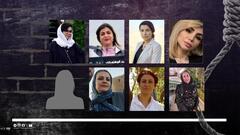
— At least four women activists, identified as Maryam Hedavand, Arghavan Fallahi, Mahnaz Chahardoli and Bita Hemmati, were sentenced to death by the judiciary of the Islamic Republic of Iran. Hemmati’s death sentence was subsequently overturned, and she is awaiting a new court ruling. Three of the women were detained during the January protests and were sentenced to death by Branches 15 and 26 of the Tehran Revolutionary Court.
— At least 44 women activists were sentenced to a combined total of 211 years and five months in prison.
— At least three women activists were sentenced to a combined total of 179 lashes.
— At least four women activists received a combined total of 14 years of suspended imprisonment.
Hengaw identifies 368 women among 5,000 arrested in the first half of 2026
Based on data and documentation collected by its Statistics and Documentation Center, Hengaw has confirmed the arrest of 5,000 women during the first half of 2026.
However, due to severe internet restrictions in recent months, particularly during the January protests and the 40-day war involving Iran, Israel and the United States, Hengaw has so far been able to fully verify the identities of only 368 of the detained women.
Further details on the 368 identified women include:
— At least 29 Baha’i women were arrested.
— At least 70 Kurdish women were arrested.
— At least 50 Lor women were arrested.
— At least 19 Gilak women were arrested.
— At least 12 Baloch women were arrested.
— At least 11 Turkish women were arrested.
— At least six female students were arrested.
— At least eight female teachers were arrested.
In addition to these 368 women, Hengaw documented the arrests of at least 23 girls under the age of 18 whose full identities have been verified.
At least 45 cases of femicide documented in the first half of 2026
According to data from Hengaw’s Statistics and Documentation Center, at least 45 women were killed in femicide cases across Iran during the first six months of 2026. Of these, five cases, equivalent to 11%, were linked to so-called “honour” motives.
Further details include:
— At least two women who had been subjected to child marriage were killed by their husbands.
— At least five women were killed in so-called “honour” killings.
— Family disputes were cited as the motive in 27 cases, representing the highest number of documented femicides.
Breakdown of femicide cases by province:
Tehran Province: 16 cases
Sistan and Baluchestan Province: 6 cases
Fars Province: 4 cases
East Azerbaijan, West Azerbaijan (Urmia) and Khuzestan provinces: 2 cases each
Yazd, Gilan, Lorestan, Mazandaran, Kerman, Kurdistan (Sanandaj), Golestan, Qazvin, Semnan, North Khorasan, Chaharmahal and Bakhtiari, Isfahan and Alborz provinces: 1 case each
Most of the documented femicides were committed by people closest to the victims, including husbands, former husbands, fathers, brothers and other family members. This remains a consistent pattern in femicide cases.
Two women killed during celebrations following the announcement of Ali Khamenei’s death
According to reports published by Hengaw, government forces opened fire on crowds during street celebrations held in cities across Iran following the announcement of Ali Khamenei’s death, killing several people.
Nahal AhouQalandari, from Khorramabad, the capital of Lorestan Province, and Faezeh Afshari, from Semirom in Isfahan Province, were killed by direct fire from government forces on February 28 and March 1, respectively, during celebrations following the announcement of Khamenei’s death.
Five female Peshmarga and guerrilla killed in bombings and military attacks
According to data recorded by Hengaw’s Statistics and Documentation Center, at least three female Peshmerga were killed in drone and missile attacks carried out by the Islamic Revolutionary Guard Corps (IRGC) against bases and camps belonging to Iranian Kurdish opposition parties inside the Kurdistan Region.
They were:
1. Ghazal Molan, from Mahabad, a Peshmerga member of the Komala Party of Kurdistan’s Toilers, killed on April 14, 2026.
2. Neda Miri, from Sanandaj (Sine), a Peshmarga member of the Democratic Party of Iranian Kurdistan, killed on April 17, 2026.
3. Samira Allahyari, from Divandarreh, a Peshmarga member of the Democratic Party of Iranian Kurdistan, killed on April 17, 2026.
In addition, two YRK guerrilla, the armed wing of PJAK, identified as Parastou Safaeipour from Marivan and Zarin Akbash from Kurdistan in Turkey, were killed on June 28, 2026, during an armed clash with IRGC forces near Mahabad.
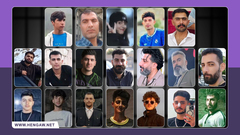
At least 250 women killed during the January protests
According to figures documented by Hengaw, at least 250 women were killed by direct fire from government forces in cities across Iran during the January 2026 protests. Hengaw has so far fully verified the identities of 206 of the women killed.
In addition to the 250 women, at least 25 girls under the age of 18 were killed. Hengaw has verified the identities of 19 of them.
The highest numbers of women killed were documented in the following provinces:
— Tehran Province: 61 women
— Isfahan Province: 29 women
— Alborz Province: 24 women
— Gilan Province: 23 women
— Razavi Khorasan Province: 22 women
According to Hengaw’s data:
— At least 22 female students were killed during the January protests.
— At least two female teachers were killed during the January protests.
— At least seven women working as doctors, nurses or other healthcare professionals were killed.
The arrest and prosecution of women remain part of a broader pattern of systemic discrimination in the Islamic Republic of Iran. Since the Woman, Life, Freedom (Jin, Jiyan, Azadi) movement, pressure on women activists has intensified considerably.
Since its establishment, the Islamic Republic of Iran has systematically sought to restrict women’s participation in social, political and human rights activities. Policies of sex and gender segregation, alongside the systematic marginalisation of sexual and gender minorities through the criminalisation of their identities, form a central part of the system of gender apartheid in Iran.
Femicide represents one of the most extreme manifestations of misogyny and violence against women in society. So-called “honour” killings account for only a portion of femicide cases. The underlying roots of femicide lie in historically entrenched patriarchal structures, relationships and discriminatory laws.
Misogynistic laws and attitudes normalise deep-rooted hostility towards women, creating an environment in which violence against women, including their killing, can be committed more easily and with limited consequences.
The Hengaw Organization for Human Rights expresses serious concern over the widespread arrest of women and the increasingly severe sentences imposed against them and assesses the state of gender inequality in Iran as deeply alarming.