Statement by Hengaw on the Iranian Parliament’s revival of Khomeini’s jihad doctrine against Kurdistan
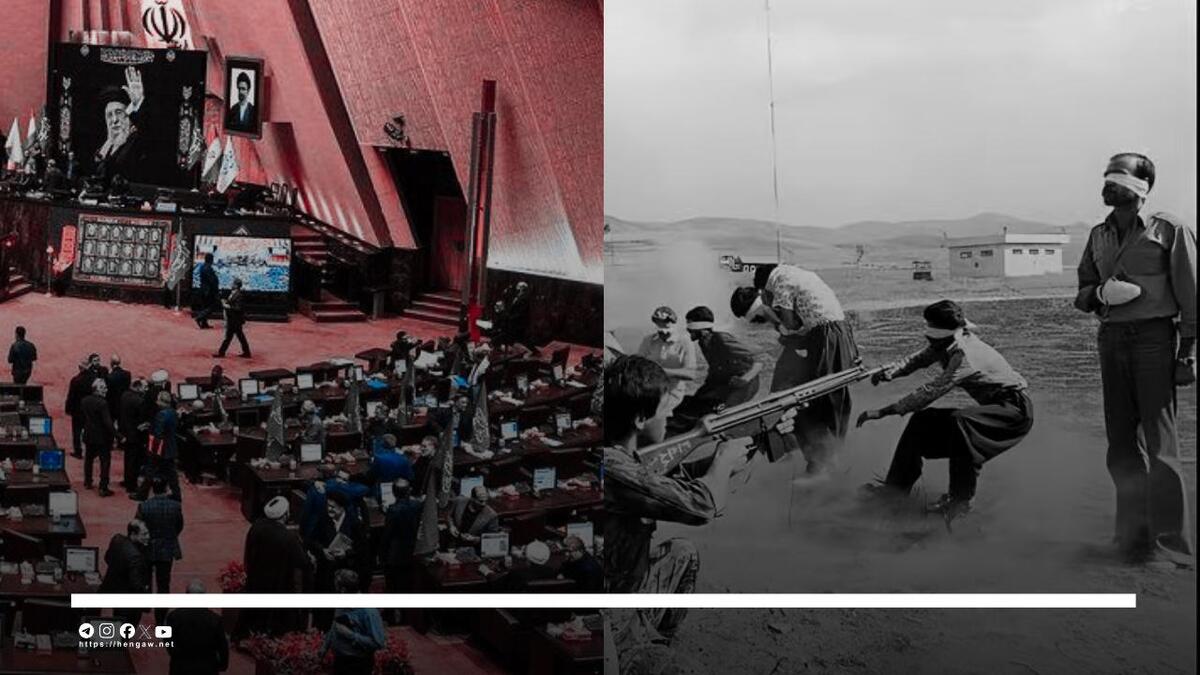
The Hengaw Organization for Human Rights expresses its profound concern over the recent legislation adopted by the Iranian Parliament, under which certain categories of individuals are to be regarded as “military personnel” regardless of whether they are armed. Hengaw strongly condemns this measure. It is not merely a change in the legal terminology of the Islamic Republic of Iran; rather, it represents another step toward expanding a definition that erases the distinction between civilians and military targets, creating a framework for legitimising political violence and the elimination of perceived opponents.
The headline published by the Iranian state-affiliated news agency ISNA, referring to “proxy terrorist groups,” framed the legislation as follows: “Following parliamentary approval, all Zionists residing in the occupied territories are considered military personnel.”
The legislation adopted by Parliament states that: “All Zionists residing in the occupied territories, CENTCOM terrorist forces, and their proxy terrorist groups, regardless of whether they carry weapons, shall be considered military personnel.”
For more than four decades, the Islamic Republic of Iran has consistently sought to portray the political parties of Iranian Kurdistan as proxies of the United States and Israel. Rather than recognising the Kurdish people’s political and human rights demands as legitimate civic and democratic aspirations, the authorities have persistently framed them as part of a foreign-backed security project. This narrative has repeatedly served as justification for the Islamic Republic of Iran’s military and security policies, including missile and drone attacks against Kurdish political parties based in the Kurdistan Region of Iraq, the assassination of Kurdish activists inside and outside Iran, the suppression of Kurdish political and civil society activists, and the imposition of death sentences and lengthy prison terms.
Although the newly adopted legislation does not explicitly mention the political parties of Iranian Kurdistan, it follows the familiar pattern of the Islamic Republic of Iran’s discourse by substituting propaganda for legal clarity. It reinforces the state’s long-standing security narrative, under which Kurdish political parties and activists are routinely portrayed as agents of Israel, the United States, or other foreign powers in an effort to strip them of their political and civilian status and redefine them as “enemies” or “foreign operatives.” This narrative ignores the historical reality that the Kurdish movement predates both the establishment of the State of Israel and the creation of the Islamic Republic of Iran itself, as well as the subsequent breakdown of Iran’s diplomatic relations with those states.
Within this framework, any individual or group accused by the authorities of cooperating with or aligning with these countries risks being deprived of the fundamental protections afforded under international humanitarian law and being portrayed as a “legitimate military target.”
Hengaw warns that the implications of this narrative extend far beyond members and officials of Kurdish political parties. Given the broad social support these parties enjoy across Kurdistan, such rhetoric could, in practice, place millions of Kurds who sympathise with, cooperate with, or are even socially or familially connected to these parties under permanent threat from the authorities. The experience of the past four decades demonstrates that the Islamic Republic of Iran has made little distinction between party members, supporters, civil society activists, journalists, family members, or ordinary citizens, routinely targeting all of them under broad national security accusations.
Hengaw further stresses that this legislation must be understood within the broader historical context of the Islamic Republic of Iran’s policies toward Kurdistan. Since August 1979, when Ruhollah Khomeini issued his order for “jihad” against Kurdistan, the authorities have consistently sought to remove their opponents from the protection of citizenship and even humanity in order to justify systematic violence against the Kurdish population.
Hengaw’s observations further show that, in recent years and decades, this narrative has been reproduced not only by the Islamic Republic of Iran itself but also by segments of the Iranian opposition. The repetition of this discourse, even by those who oppose the Islamic Republic of Iran, ultimately reinforces the same propaganda and security framework that the authorities have long relied upon to justify the repression and elimination of Kurdish political opponents. At a time when the Islamic Republic of Iran is facing an unprecedented crisis of legitimacy, the outsourcing and reproduction of key elements of this narrative by parts of the Iranian opposition risks restoring a degree of public legitimacy to the state’s policy of violence against Kurdistan.
Hengaw calls on the United Nations, the Special Rapporteurs, international human rights mechanisms, and all governments committed to upholding international law to respond to this alarming development. The international community must not allow the Islamic Republic of Iran to use new interpretations of its legal and security framework to further legitimise an even broader campaign of violence against Kurdistan.