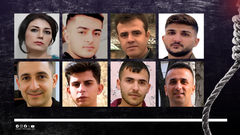
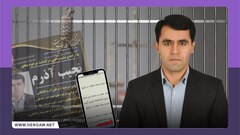
Families denied bodies of secretly executed Kurdish political prisoners Naser Bakrzadeh and Mehrab Abdollahzadeh
Hengaw – Monday, May 18, 2026
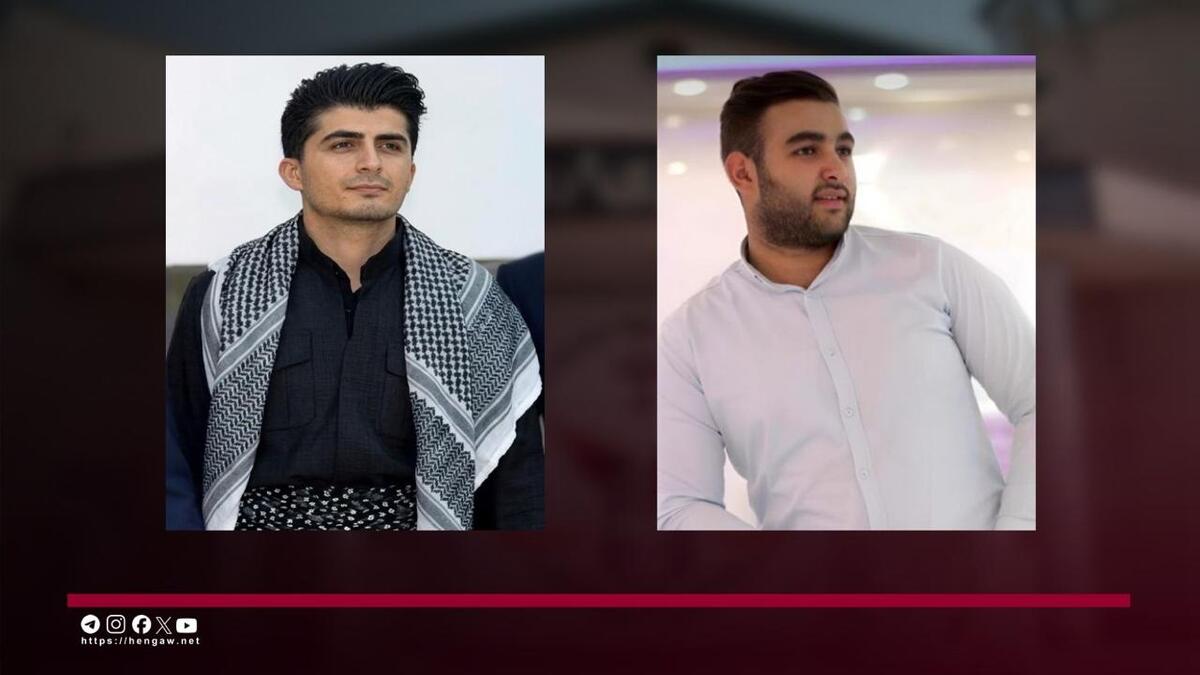
More than two weeks after the secret executions of Naser Bakrzadeh and Mehrab Abdollahzadeh, two Kurdish political prisoners from Urmia, authorities have yet to return their bodies to their families and have barred public mourning ceremonies in the city.
According to information received by Hengaw Organization for Human Rights, despite repeated follow-ups by the families, officials at Urmia Central Prison have refused to hand over the bodies and reportedly told relatives that “no bodies will be returned.” Authorities also prevented memorial ceremonies from being held in Urmia by blocking gatherings at the families’ homes, forcing relatives to hold limited mourning ceremonies in their native villages instead.
The executions were carried out in secret without granting either prisoner a final visit with family members or notifying their lawyers in advance.
Hengaw has learned that following the executions, the families of both prisoners were summoned and threatened by security institutions, including the Intelligence Department, and warned against holding memorial services in Urmia. A mourning ceremony for Naser Bakrzadeh was ultimately held in the village of Golaz in Oshnavieh (Shno) County, while a ceremony for Mehrab Abdollahzadeh took place in the village of Khoshalan near Urmia with only a limited number of attendees.
According to an informed source, after the execution of 26-year-old Kurdish political prisoner Naser Bakrzadeh on May 2, government forces contacted his family by phone and told them: “We executed your son and threw away his body. Go find it yourselves.”
Hengaw Organization for Human Rights considers the executions and continued withholding of the prisoners’ bodies to be clear examples of enforced disappearance and state killing, carried out in violation of international fair trial standards and fundamental human rights principles.
The case of Naser Bakrzadeh
Naser Bakrzadeh’s death sentence was upheld for a third time by the Supreme Court on April 19 after two previous rulings had been overturned and referred to parallel branches for review. His lawyers were informed of the final ruling five days later, on April 24.
Despite an urgent request for judicial review submitted by his lawyers, Bakrzadeh was summoned on April 29 to meet with an official from the Enforcement of Sentences Office at the Revolutionary Prosecutor’s Office. He was then removed from prison in a refrigerated vehicle and transferred to an undisclosed location.
Following the third confirmation of his death sentence, Bakrzadeh’s parents released a video in May appealing for the execution to be halted and repeatedly insisting on their son’s innocence. After the video was published, he reportedly came under renewed security pressure before being transferred from Urmia Central Prison to an undisclosed location on April 29.
Amir Raisian, one of Bakrzadeh’s lawyers, later announced that access to the case file through the judiciary’s Sana system had been restricted and that no information regarding possible decisions in the case was available.
Another lawyer, Seydad Shirzadeh, wrote on X that Branch 2 of the Urmia Revolutionary Court had sentenced Bakrzadeh to death for a third time despite Branch 39 of the Supreme Court twice overturning the verdict over serious legal flaws. According to Shirzadeh, the deficiencies identified by the Supreme Court remained unresolved in the final ruling and were ignored by the Revolutionary Court.
Branch 1 of the Urmia Revolutionary Court, presided over by Judge Najafzadeh, sentenced Bakrzadeh to death on charges of “spying for Israel” on November 2, 2024. The verdict was later overturned on appeal by Branch 39 of the Supreme Court and referred to a parallel branch.
He was later retried by Branch 2 of the Urmia Revolutionary Court, headed by Judge Shahini, and again sentenced to death on the same charge. That ruling was also overturned in November 2025 by Branch 39 of the Supreme Court and referred once more to a parallel branch. A new death sentence was issued in February 2026 and ultimately confirmed by the Supreme Court on April 24.
Bakrzadeh was first arrested by the Intelligence Organization of the Islamic Revolutionary Guard Corps (IRGC) in Urmia on August 9, 2023, and was temporarily released several weeks later after signing a written commitment.
He was rearrested by IRGC intelligence forces in Urmia on January 2, 2024, and, after months of interrogation under torture and pressure at the Al-Mahdi IRGC detention center, transferred to Urmia Central Prison.
Following his execution, state media broadcast a video containing what appeared to be forced confessions by Bakrzadeh and fellow executed political prisoner Yaghoub Karimpour, accusing them of espionage. The footage underscored the Iranian judiciary’s continued reliance on confessions allegedly extracted under torture in cases involving the death penalty despite serious legal concerns surrounding the proceedings.
In the video, Bakrzadeh appears in an undisclosed location reading from a prepared text in front of a camera. He says he had sent photographs of government sites, including police stations, through social media. The report further claimed that he had intended to photograph sensitive locations such as Natanz and Parchin before being arrested.
After spending several months in the Kurdistan Region, Bakrzadeh voluntarily returned to Urmia believing there was no evidence against him, only to later face a death sentence by the Iranian judiciary.
Naser Bakrzadeh was executed alongside Yaghoub Karimpour at dawn on Saturday, May 2, 2026, at Urmia Central Prison.
The case of Mehrab Abdollahzadeh
In Mehrab Abdollahzadeh’s case, the Judiciary Media Center claimed that he and several others were involved in the assault and killing of a Basij member named Abbas Fatemiyeh during the “Jin, Jiyan, Azadi” protests in Nushinshahr near Urmia.
From the outset, the case relied heavily on “the judge’s knowledge” and alleged forced confessions, while no credible evidence existed to substantiate the charges. Abdollahzadeh was prosecuted alongside around sixty other defendants and was initially identified as the second defendant in the case. However, after many of the other defendants were released or left the country, he became the only accessible defendant and was sentenced to death despite repeated requests for forensic analysis of video footage, mobile phone location data, and scientific image verification.
Authorities proceeded without presenting conclusive evidence and ignored repeated requests for judicial review.
Branch 1 of the Urmia Revolutionary Court, presided over by Judge Najafzadeh, sentenced Abdollahzadeh to death on charges of “armed rebellion” (baghi) and “corruption on earth” (efsad-e fel-arz). Throughout the proceedings, he repeatedly denied the accusations and stated that his confessions had been extracted under severe torture in security detention centers.
Branch 39 of the Supreme Court rejected Abdollahzadeh’s request for retrial on February 17, 2026. Although another request for judicial review was later submitted, no order suspending the execution was issued, and the sentence was carried out despite ongoing legal proceedings.
The death sentence had previously been upheld by Branch 9 of the Supreme Court. The ruling was formally communicated to Abdollahzadeh in prison on December 18, 2025, and he was instructed to submit a request for clemency.
During the first family visitation session for political and ideological prisoners after a three-month suspension on April 28, Abdollahzadeh reportedly protested insults and mistreatment directed by a prison guard, Amirreza Ghaznavi, toward prisoners’ families. Following an altercation with the guard, Urmia Prison director Peyman Khanzadeh ordered that he be transferred to solitary confinement in handcuffs and shackles as punishment.
Abdollahzadeh was abducted by government forces during the “Jin, Jiyan, Azadi” movement in autumn 2022 and transferred to a security detention center in Urmia. After months of torture and interrogation, he was later moved to Urmia Central Prison.
Following his execution, state media released silent CCTV footage without any visible date or timestamp and claimed the individual seen attacking another person in the video was Abdollahzadeh striking Abbas Fatemiyeh. No evidence establishing the authenticity of the footage was provided, and it remains unclear whether the video was even related to the “Jin, Jiyan, Azadi” protests. Neither the time nor location of the alleged incident was disclosed.
Mehrab Abdollahzadeh, a 27-year-old Kurdish political prisoner from Urmia detained during the “Jin, Jiyan, Azadi” movement, was secretly executed at dawn on Sunday, May 3, 2026, at Urmia Central Prison.
Hengaw emphasizes that both political prisoners were subjected to severe torture and forced confessions throughout their detention and were denied fair trial rights. Their executions were carried out despite serious legal ambiguities surrounding their cases. Hengaw further believes the executions, carried out amid tensions related to the war involving Iran, the United States, and Israel, reflect the Islamic Republic’s use of wartime conditions to intensify repression, settle scores with political prisoners, and spread fear through executions.