At least 109 prisoners executed in Iran during June 2026
Hengaw– Saturday, July 4, 2026
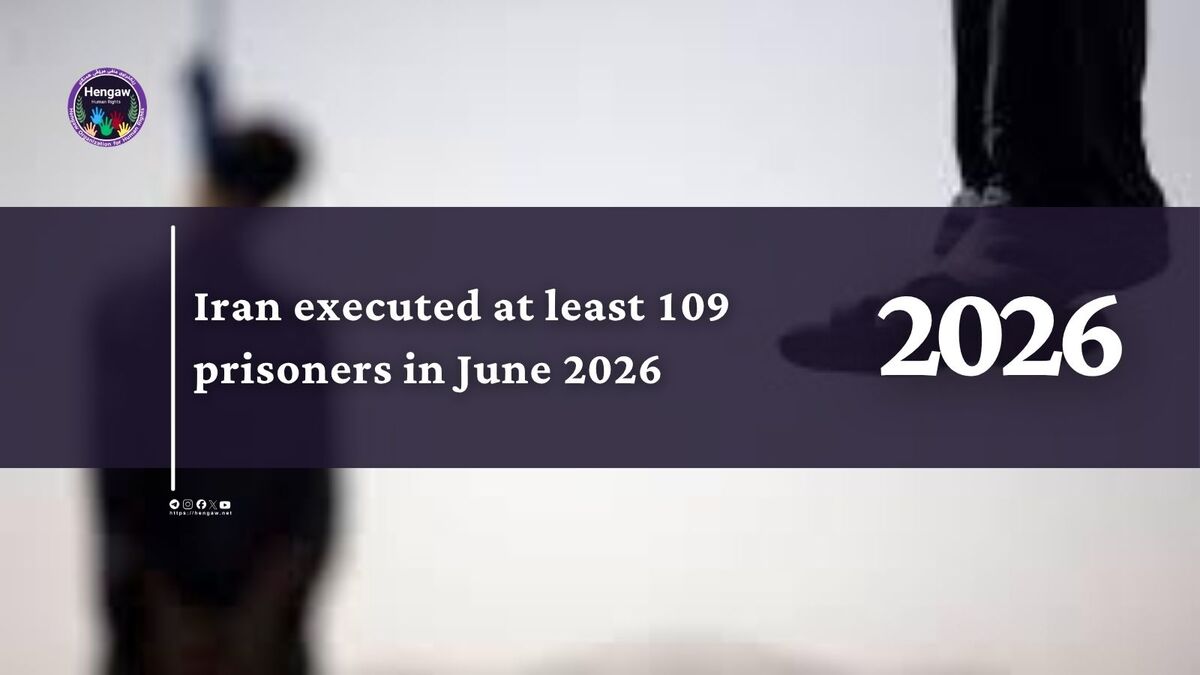
During the past calendar month, the death sentences of at least 109 prisoners, including 5 political prisoners, were carried out in various prisons across Iran. This figure represents an increase of at least 10 cases (equivalent to 10%) compared to the same period last year. In June 2025, at least 99 prisoners had been executed in Iranian prisons.
The full identities of all 109 executed prisoners have been verified by Statistics and Documentation Center of the Hengaw Organization for Human Rights.
The death sentences of three women were carried out, last month. Afsaneh Zandabadi, from Tabriz, was executed on drug-related charges, while Asiyeh Farahmand and Zeynab Zarini were both executed in Qazvin Central Prison on charges of the premeditated murder of their shared husband.
Out of the total 109 prisoners executed in June, only 7 cases (equivalent to 6.5% of all cases) were announced by official Iranian sources and websites affiliated with the judiciary.
Furthermore, the death sentences of 12 prisoners were carried out secretly, without notifying their families and denying them the right to a final visit.
Execution of 5 political prisoners
During the past month, at least five political prisoners—who were among those detained during the January protests, including two Kurdish political prisoners—were executed on charges such as Moharebeh (Waging war against God). Their identities are as follows:
- Ashkan Maleki, a Kurdish political prisoner from Qorveh, who was executed on espionage charges on June 1, 2026, in Ghezel Hesar Prison in Karaj.
- Mehrdad Mohammadinya, a Kurdish political prisoner from Qorveh, who was executed on espionage charges on June 1, 2026, in Ghezel Hesar Prison in Karaj.
- Fathollah Avari, a political prisoner from Hamedan, who was executed on June 6, 2026, in Hamedan Central Prison.
- Javad Zamani, a political prisoner from Shahroud, who was executed on June 6, 2026, in Shahroud Central Prison.
- Abolfazl Saedi, a political prisoner from Shahroud, who was executed on June 6, 2026, in Shahroud Central Prison.
Breakdown of executed prisoners by charge
In June of this year, the highest number of executions involved prisoners accused of premeditated murder, accounting for 54 cases (49.5% of the total). Additionally, 44 individuals were executed on drug-related charges, and 5 individuals were executed for political reasons and espionage charges.
- Political and espionage charges: 5 cases
- Premeditated murder charges: 54 cases
- Drug-related crime charges: 44 cases
- Rape charges: 5 cases
- Armed robbery charges: 1 case
Breakdown of executions by national and ethnic minorities
During the past month, the death sentences of at least 31 Persian prisoners were carried out, equivalent to 28.5% of all cases. Additionally, 18 Kurdish prisoners and 18 Baloch prisoners (collectively equivalent to 33% of all cases), 12 Lor prisoners, and 10 Turkish prisoners were executed.
- Kurdish: 18 cases
- Baloch: 18 cases
- Lor: 12 cases
- Turkish: 10 cases
- Gilak and Mazandaranis: 5 cases
- Arab: 5 cases
- Turkmen: 1 case
- Persian: 31 cases
- Afghan nationals: 5 cases
- Unknown: 4 cases
Breakdown of executions by provincial prisons
In the last month, death sentences were carried out across 24 provinces. The highest number of death sentences was recorded in the prisons of Isfahan province, totaling 15 cases. Following Isfahan province, the highest execution numbers were recorded in the prisons of Sistan and Baluchestan province with 10 cases, and Fars province with 9 cases.
- Isfahan province: 15 cases
- Sistan and Baluchestan province: 10 cases
- Fars province: 9 cases
- Hamadan province: 7 cases
- Kurdistan (Sanandaj), Yazd, Razavi Khorasan, and Alborz provinces: 6 cases each
- Khuzestan, Semnan, and North Khorasan provinces: 5 cases each
- Kermanshah (Kermashan) and East Azerbaijan provinces: 4 cases each
- Mazandaran, Lorestan, and South Khorasan provinces: 3 cases each
- Hormozgan, Golestan, Qazvin, and West Azerbaijan (Urmia) provinces: 2 cases each
- Guilan, Kohgiluyeh and Boyer-Ahmad, Qom, and Kerman provinces: 1 case each