Six female political prisoners face execution in Iran; two others at risk of renewed death sentences
Hengaw – Thursday, July 30, 2026
Six female political prisoners and prisoners of conscience in Iran are at imminent risk of execution, while two other women could again face death sentences after Iran's Supreme Court overturned their previous death penalties and ordered retrials.
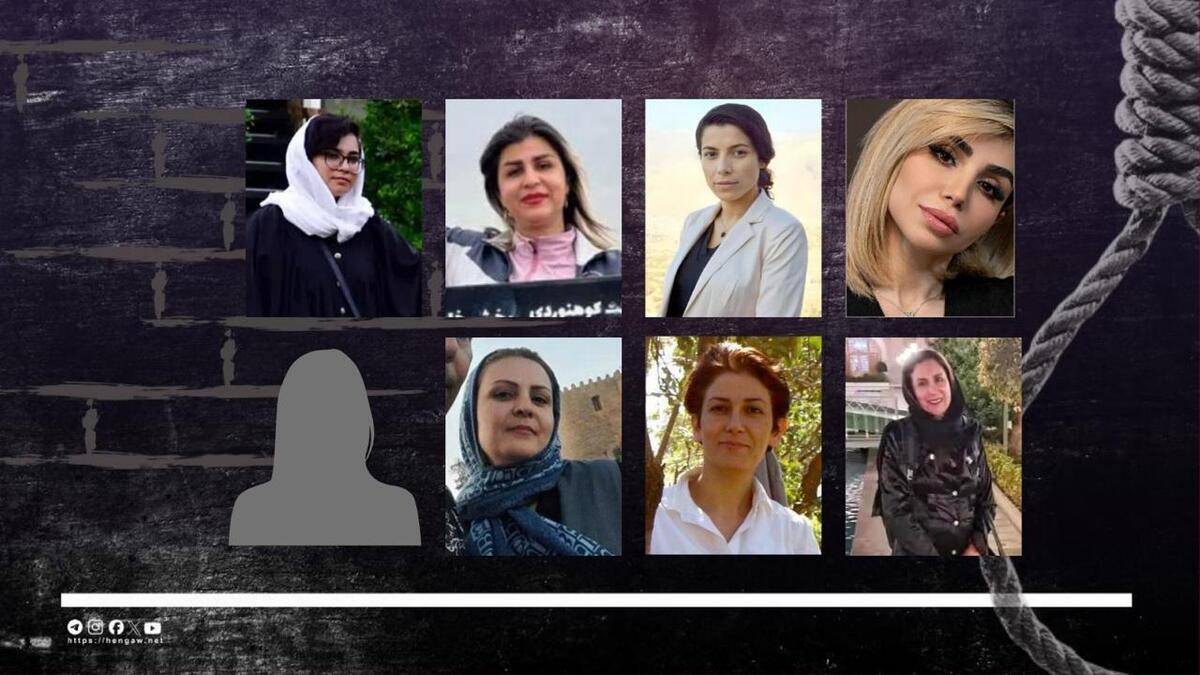
The six women currently under death sentences are Zahra Shahbaz Tabari, Pakhshan Azizi, Nasimeh Eslamzehi, Maryam Hodavand Siri, Arghavan Fallahi, and Mahnaz Chardoli. The two others, Varisheh Moradi and Bita Hemmati, remain at risk of receiving renewed death sentences as their cases await new rulings.
Iranian authorities have prosecuted all eight women on political and security-related charges without presenting clear or credible evidence and through proceedings that failed to meet fair trial standards. Their cases have relied on forced confessions obtained under torture, while the current climate of heightened repression in Iran has intensified concerns that the death sentences could soon be be carried out.
The women are being held at Evin Prison in Tehran and prisons in Rasht, where they have been denied fundamental rights throughout their detention. Three of the eight women were arrested during the January 2026 protests.
Women at risk of execution:
Zahra Shahbaz Tabari
Zahra Shahbaz Tabari, a 68-year-old Gilak civil rights activist and political prisoner from Rasht, was sentenced to death on May 28, 2026, by Branch 1 of the Rasht Revolutionary Court, presided over by Judge Ahmad Darvish Goftar.
The court convicted her of baghi (armed rebellion) through alleged membership in the People’s Mojahedin Organization of Iran.
The same court had previously sentenced Shahbaz Tabari to death in October 2025. The Supreme Court overturned the ruling on January 27, 2026, and returned the case to the original branch for retrial. Despite the Supreme Court’s decision, the court sentenced her to death again.
The security case against Shahbaz Tabari is based on limited, fabricated, and unreliable material, including a piece of cloth bearing the slogan “Woman, Resistance, Freedom” and an unpublished voice message. No evidence has been presented demonstrating that she had any organizational, structural, or military connection with any group.
Shahbaz Tabari is an electrical engineer, a member of Iran’s Construction Engineering Organization, and holds a master’s degree in sustainable energy from the University of Borås in Sweden.
Security forces arrested her on April 16, 2025, after raiding her home, searching the property, and confiscating her electronic devices. She was subsequently transferred to Lakan Prison in Rasht.
She had previously been detained for three months over peaceful protest-related posts on social media and was later released under electronic monitoring.
Pakhshan Azizi
Pakhshan Azizi, a 42-year-old Kurdish political prisoner from Mahabad, women's rights activist, and social worker, was sentenced to death on June 13, 2024, by Branch 26 of the Tehran Revolutionary Court, presided over by Judge Iman Afshari, on the charge of baghi (armed rebellion).
Branch 39 of Iran’s Supreme Court subsequently upheld the sentence, and the court has rejected her requests for a retrial twice.
Intelligence Ministry forces arrested Azizi in Tehran’s Kharazi residential complex on August 4, 2023. She is currently being held in the women’s ward of Evin Prison.
Authorities transferred her on December 11, 2023, from Ward 209 of Evin Prison, which is controlled by the Intelligence Ministry, to the prison’s women’s ward.
They later opened a separate case against Azizi at Branch 3 of the Evin Prosecutor’s Office on the charge of “rioting in prison” and sentenced her to an additional six months in prison.
Azizi had previously been arrested on November 16, 2009, during a protest by Kurdish students at the University of Tehran against the execution of political prisoners in Kurdistan. She was released on March 19, 2010, after four months in detention and after posting bail of 100 million tomans.
Persistent pressure and threats from security agencies later forced Azizi to leave Iran. She conducted research on the situation of women in the Kurdistan Region of Iraq and Kurdistan of Syria, also known as Rojava, and worked as a social worker to improve women’s conditions.
Nasimeh Eslamzehi
Nasimeh Eslamzehi, a 41-year-old Baloch prisoner of conscience, mother of two, and resident of Saravan, was sentenced to death on October 5, 2025, alongside her husband, Arsalan Sheikhi, and another prisoner identified only as Hassan.
Branch 15 of the Tehran Revolutionary Court, presided over by Judge Abolghasem Salavati, convicted the three in a joint case of moharebeh (enmity against God) through alleged “membership in the Islamic State group.”
Iranian security agencies accused Eslamzehi and the two other defendants of carrying out the bombing of a passenger bus travelling from Tehran to Ilam in September 2023. The incident resulted in the death of an 18-month-old child.
Eslamzehi was pregnant when she was arrested. Seven months later, she gave birth in prison to a daughter named Tasnim. Following the birth, authorities held the mother and newborn for 40 days in a solitary-confinement cell with inadequate ventilation and lighting before transferring them to a quarantine ward.
Security forces arrested Eslamzehi and the two other defendants in Malard, Tehran Province, on September 6, 2023, and transferred them to Zahedan for interrogation.
Authorities moved her from a security detention facility to the women’s ward of Evin Prison on March 4, 2024. Following an Israeli missile strike on the Evin Prison compound, she was transferred to Qarchak Prison in Varamin.
Iranian authorities executed her husband, Arsalan Sheikhi, at Qezel Hesar Prison in Karaj on January 24, 2026.
Maryam Hodavand Siri
Maryam (Mahtab) Hodavand Siri, a 40-year-old Lor political prisoner, mother of two, and detainee from the January 2026 protests, was sentenced to death by Branch 26 of the Tehran Revolutionary Court, presided over by Judge Iman Afshari.
The court sentenced her to death over her alleged involvement in the case known as the “Seyed al-Shohada Mosque fire” in Pakdasht.
Hodavand Siri was denied access to an independent lawyer throughout the judicial process, and the proceedings were conducted in a highly securitized and non-transparent environment.
Following an appeal, her case was referred to Branch 9 of the Supreme Court for review.
Security forces arrested Hodavand Siri in Tehran Province during the January 2026 protests. After completing interrogation, she was transferred to the women’s ward of Evin Prison.
Arghavan Fallahi
Arghavan Fallahi, a 24-year-old political prisoner held at Evin Prison, was sentenced to death by Branch 15 of the Tehran Revolutionary Court, presided over by Judge Abolghasem Salavati.
The court convicted her of baghi (armed rebellion) through alleged “membership in groups opposed to the state and armed action.”
Security forces arrested Fallahi in late January 2025. Following an Israeli missile strike on the Evin Prison compound, authorities transferred her first to Greater Tehran Prison, also known as Fashafuyeh Prison, and then to Qarchak Prison in Varamin. She was later returned to the women’s ward of Evin Prison.
After her arrest, Fallahi spent months in security wards 209, controlled by the Intelligence Ministry, and 241, controlled by the judiciary’s Intelligence Protection Organization. During this period, she was subjected to severe physical and psychological torture.
Security agencies pressured her to make forced confessions as part of an effort to implicate her in an alleged attempt to assassinate two judges, Mohammad Moghiseh and Ali Razini.
Fallahi had previously been arrested alongside her father in November 2022 during the Woman, Life, Freedom movement.
Branch 26 of the Tehran Revolutionary Court, presided over by Judge Iman Afshari, later sentenced her to two years in prison on charges of “assembly and collusion” and “propaganda against the state.” She was released after completing the sentence in full.
Mahnaz Chardoli
Mahnaz Chardoli, a detainee from the January 2026 protests who is currently held at Evin Prison, was sentenced to death alongside her fiancé, Mehdi Nazer, by Branch 15 of the Tehran Revolutionary Court, presided over by Judge Abolghasem Salavati.
In addition to the death sentence, Chardoli was sentenced to 10 years in prison.
Security forces arrested Chardoli, Mehdi Nazer, and Nazer’s sister, Atefeh Nazer, during the protests on January 11, 2026.
The charges cited against them include “attacking a mosque with Molotov cocktails,” “participating in illegal gatherings,” and “assembly and collusion.”
Women at risk of renewed death sentences:
Varisheh Moradi
Varisheh Moradi, a Kurdish political prisoner from Sanandaj and a member of the Community of Free Women of East Kurdistan, known as KJAR, is being held in the women’s ward of Evin Prison.
Branch 15 of the Tehran Revolutionary Court, presided over by Judge Abolghasem Salavati, previously sentenced her to death on the charge of baghi (armed rebellion) through alleged membership in the Kurdistan Free Life Party, known as PJAK.
Branch 9 of the Supreme Court overturned the sentence because of incomplete investigations and returned the case to Branch 15 of the Tehran Revolutionary Court for retrial.
In a separate joint case involving four other political prisoners held at Evin Prison, Branch 2 of the Criminal Court at Tehran’s Quds Judicial Complex, presided over by Judge Abolfazl Ameri Shahrabi, sentenced Moradi to six months in prison.
She received a further six-month prison sentence in another case on the charge of “propaganda against the state” for writing a letter marking the anniversary of the Woman, Life, Freedom movement. The sentence was added to her previous and pending cases.
Intelligence Ministry forces arrested Moradi on August 1, 2023, while she was travelling from Marivan to Sanandaj. Officers severely beat her during the arrest and transferred her to a detention facility without providing medical treatment.
After spending five months in solitary confinement, authorities transferred her from Ward 209 of Evin Prison to the women’s ward on December 26, 2023.
She had been moved to Ward 209 in late August 2023 after being interrogated and tortured at the Intelligence Department detention facility in Sanandaj.
Bita Hemmati
Iran’s Supreme Court overturned the death sentences imposed on Bita Hemmati and her husband, Mohammadreza Majidi Asl, both residents of Tehran and detainees from the January 2026 protests. The court referred their case to a parallel branch for retrial.
In late April 2026, Branch 26 of the Tehran Revolutionary Court, presided over by Judge Iman Afshari, sentenced Hemmati, Majidi Asl, and their two co-defendants, Behrouz Zamaninejad and Kourosh Zamaninejad, to death on the charge of “operational activity for the hostile government of the United States and hostile groups.”
In addition to the death sentences, the court sentenced each of the four defendants to five years in prison on the charge of “assembly and collusion against national security.” It also ordered the confiscation of all their property as an additional punishment.
The Revolutionary Court cited conduct including “participating in gatherings on January 8 and 9,” “chanting slogans,” and “damaging public property.” It also referred to unsubstantiated claims involving “throwing incendiary materials and using an unspecified weapon.”
The written judgment, however, provided no precise or individualized evidence establishing the alleged role of each defendant.
Security forces arrested all four defendants during protests in Tehran on January 9, 2026.
Hengaw previously reported that interrogators subjected them to severe physical and psychological pressure in an effort to obtain forced confessions. They were also denied access to lawyers of their choosing and other fundamental fair-trial guarantees throughout the judicial proceedings.