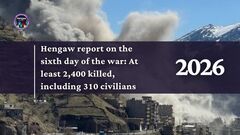
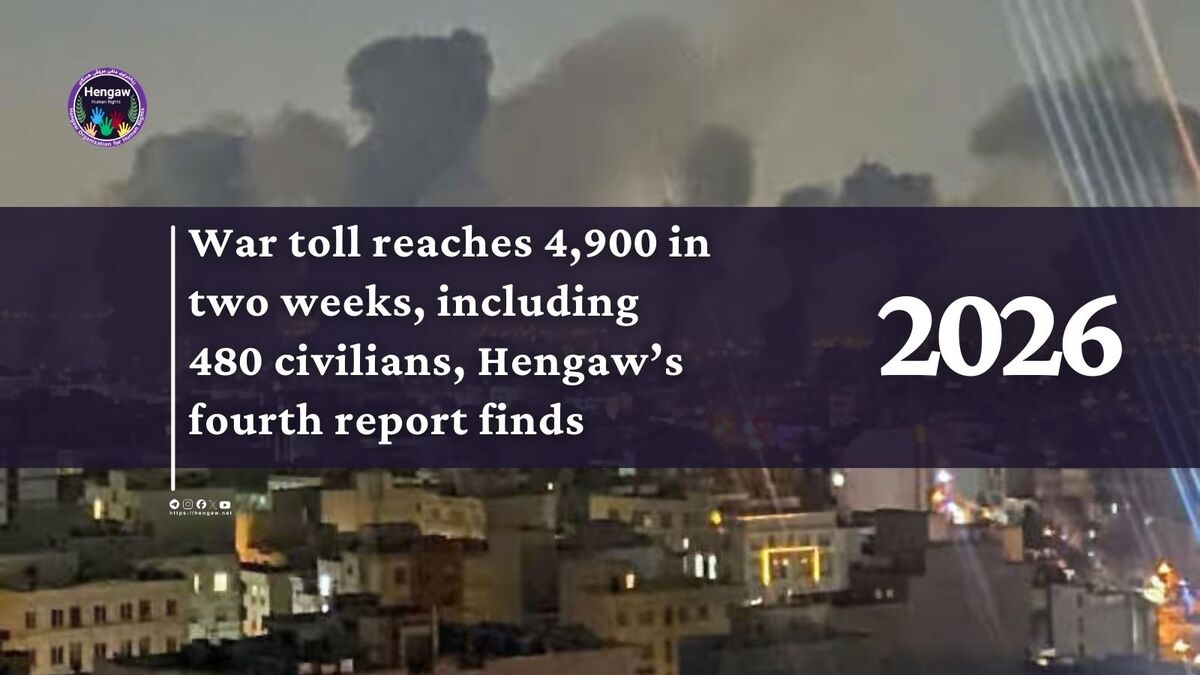
War toll reaches 4,900 in two weeks, including 480 civilians, Hengaw’s fourth report finds
Hengaw – Saturday, March 14, 2026
At least 4,900 people have been killed during the first 14 days of the war between the United States, Israel, and the Islamic Republic of Iran, according to data compiled by Hengaw Organization for Human Rights.
Verified data from Hengaw’s Statistics and Documentation Center shows that 480 of the victims were civilians, accounting for 9.8 percent of the total death toll, while 4,420 were members of Iranian military forces.
Geographic scope of the attacks and breakdown of casualties
Military and government facilities belonging to the Islamic Republic of Iran were targeted in at least 177 cities across 25 provinces in Israeli and U.S. air and missile strikes during the first two weeks of the war. Field documentation shows that these attacks took place between Saturday, February 28, and Friday, March 13, 2026.
The targets included Islamic Revolutionary Guard Corps (IRGC) bases, Basij centers, military airports, missile sites, police stations, judicial institutions, intelligence headquarters, army garrisons, and special forces bases.
Available documentation indicates that 4,420 Iranian government military personnel have been killed, the majority belonging to the air force, the Islamic Revolutionary Guard Corps, and the Iranian army.
The highest number of military casualties has been recorded in the provinces of Tehran, Kermanshah, Hormozgan, Kurdistan, and Sistan and Baluchestan.
Security institutions of the Islamic Republic have adopted a policy of systematic concealment, refraining from publishing the true number of casualties. In the limited cases where figures have been released, the numbers have been significantly lower than those documented on the ground.
At least 480 civilians killed in the first 14 days of war
The highest number of civilian casualties has been recorded in Hormozgan Province. Available documentation shows that a large proportion of those killed were primary school girls at Shajareh-Tayyebeh Elementary School.
In addition to Hormozgan, civilian deaths, including dozens of women and children, have also been documented in the provinces of Tehran, Kurdistan (Sanandaj), Kermanshah (Kermashan), Fars, Razavi Khorasan, Qazvin, Alborz, Ilam, Markazi, Lorestan, West Azerbaijan (Urmia), and East Azerbaijan.
A total of 480 civilians have so far been killed in the attacks, representing 9.8 percent of the total victims.
Multiple reports obtained by Hengaw indicate that Iranian military forces abandoned formal bases and relocated to civilian and public locations, including schools, student dormitories, and mosques situated within residential areas. Under the Geneva Conventions, such practices constitute the use of “human shields”, placing civilian lives at serious risk.
Heavy military losses in Kurdistan and concealment of casualty figures
Intensive airstrikes carried out by Israeli and U.S. warplanes targeted military and government facilities during the first two weeks of the war. In 35 cities across the provinces of Ilam, Kermanshah (Kermashan), Kurdistan (Sanandaj), and West Azerbaijan (Urmia), at least 200 military bases and security centers belonging to the Islamic Republic were struck.
Investigations show that at least 1,300 Iranian military and government forces have been killed in these four provinces alone during the first 14 days of the war.
At least 80 civilians were also killed during these attacks, with the highest numbers recorded in the cities of Urmia, Sanandaj (Sine), Divandarreh, Eyvan-e Gharb, Ilam, Naqadeh, Bukan, and Kermanshah.
In a previous report, Hengaw noted that security institutions have refused to disclose accurate military casualty figures, particularly in cities across Kurdistan. In the few instances where figures have been released, they have been far lower than those documented by local sources.
The organization reiterates the urgent need for transparency in identifying victims and for the protection of civilians during armed conflict in accordance with international conventions.
Hengaw’s call
Referring to the Fourth Geneva Convention on the protection of civilians during wartime, Hengaw Organization for Human Rights emphasizes that parties to the conflict are obligated to strictly distinguish between military and civilian targets.
The organization calls on the international community, particularly the United Nations Security Council and international human rights monitoring bodies, to closely monitor civilian casualties and, in light of the Islamic Republic’s policy of concealment, to compel all parties involved in the conflict to take immediate measures to protect civilian lives.