Hengaw statistical report on fundamental rights violations against Kurdish people in Iran during the first half of 2026
Hengaw – Friday, July 10, 2026
The Hengaw Organization for Human Rights publishes a comprehensive report documenting violations of the fundamental rights of Kurdish people in Iran during the first half of 2026, highlighting an increase in systematic violence and rights violations committed by government institutions.
According to data recorded by Hengaw’s Statistics and Documentation Center, the following violations were documented during the first six months of 2026:
- 46 Kurdish prisoners executed, including eight political prisoners
- 290 Kurdish people killed in the January protests
- 23 Kurdish children and 24 Kurdish women killed during the January protests
- Five Kurdish civilians killed by direct gunfire from government forces
- At least six Kolbars killed or wounded
- Six Kurdish political prisoners sentenced to death
- 27 Kurdish people sentenced to a combined total of 106 years, three months and 17 days in prison
- Four Kurdish activists, including one woman, sentenced to a combined total of 275 lashes
- More than 10,000 Kurdish people arrested, with the identities of 861 individuals verified
- At least 71 Kurdish children under the age of 18 arrested
- At least 69 Kurdish women arrested
- Three landmine casualties documented, including a 13-year-old child
- Three cases of femicide documented
At least 46 Kurdish prisoners executed during the first half of 2026
At least 46 Kurdish prisoners were executed in prisons across Iran during the first six months of 2026. Of these, 36 were executed in the past two months alone. Kurdish prisoners accounted for 12% of all executions carried out in Iran during this period. A total of 385 prisoners were executed across the country during the first half of the year.
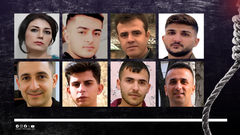
At least 48 political and religious prisoners were executed in Iran during the same period. Eight of them, equivalent to 17%, were Kurdish political prisoners. They were identified as Nasser Bakrzadeh from Urmia; Mehrab Abdollahzadeh from Urmia; Ramin Zaleh from Naqadeh; Karim Maroufpour from Naqadeh; Ashkan Maleki from Qorveh; Mehrdad Mohammadinia from Qorveh; Arsalan Sheikhi from Sardasht; and Amanj Karavanchi from Sardasht.
Further breakdown by charges leading to execution:
- Political, religious and espionage-related charges: 8 prisoners
- Premeditated murder: 24 prisoners
- Drug-related offences: 10 prisoners
- Rape and sodomy charges: 2 prisoners
- Breakdown of executed Kurdish prisoners by province:
- Kermanshah (Kermashan) Province: 16 cases
- West Azerbaijan (Urmia) Province: 13 cases
- Kurdistan (Sanandaj) Province: 11 cases
- Razavi Khorasan, Lorestan and North Khorasan provinces: 2 cases each
290 Kurdish people killed during the January protests
Nearly six months after the January 2026 protests, Hengaw has verified the full identities of 290 Kurdish people killed during the demonstrations.
Hengaw has learned that two died under torture following their arrest, two were executed after being detained, and two others were killed when government forces raided their hiding place after four months in hiding. The remaining 284 were killed by direct gunfire from government forces during the protests.
Further details on those killed:
- At least 23 Kurdish children under the age of 18 were killed, including four girls.
- At least 24 Kurdish women were killed during the protests.
- At least 11 Kurdish university students were killed, including four women.
- At least three teachers and university professors were killed.
Breakdown of Kurdish people killed by province where the deaths occurred:
- Tehran Province: 92 cases
- Kermanshah (Kermashan) Province: 89 cases
- Alborz Province: 36 cases
- Razavi Khorasan Province: 24 cases
- Ilam Province: 11 cases
- North Khorasan Province: 10 cases
- Gilan Province: 7 cases
- Qazvin Province: 6 cases
- Lorestan Province: 4 cases
- Hormozgan Province: 3 cases
- Kurdistan (Sanandaj), Markazi and Isfahan provinces: 2 cases each
- Mazandaran and Khuzestan provinces: 1 case each
- Five Kurdish civilians killed by government forces
At least five Kurdish civilians killed after the January protests
Three of the victims were killed by direct fire from government forces in Sanandaj and Bijar during the 40-day war. Two Kurdish brothers and followers of the Yarsan religion, Meysam Veisi and Mojtaba Veisi, had been forced into hiding following the January protests in Kermanshah (Kermashan). Four months later, they were killed during a raid by government forces on their hiding place in Dalahu County.
Hengaw verifies identities of 861 Kurdish people among more than 10,000 arrested
Hengaw’s data and findings indicate that at least 10,000 Kurdish people were arrested by institutions of the Islamic Republic of Iran during the first half of 2026. Despite internet shutdowns and severe restrictions on communication with its sources, Hengaw has so far verified the identities of 861 of those detained.
Further details on those arrested:
- At least 71 Kurdish children under the age of 18 were arrested, including six girls.
- At least 69 Kurdish women were arrested during the six-month period.
- At least 11 Kurdish university students were arrested.
- At least 10 teachers and university professors were arrested.
Breakdown of arrests by province:
- Ilam Province: 281 arrests
- Kermanshah (Kermashan) Province: 179 arrests
- Kurdistan (Sanandaj) Province: 159 arrests
- West Azerbaijan (Urmia) Province: 139 arrests
- North Khorasan Province: 38 arrests
- Hamedan Province: 35 arrests
- Razavi Khorasan Province: 27 arrests
- Lorestan Province: 3 arrests
Kurdish political and civil activists face death sentences, imprisonment and flogging
At least 33 Kurdish people were sentenced by the judiciary of the Islamic Republic of Iran during the first six months of 2026, receiving punishments including the death penalty, imprisonment and flogging. Additionally, at least six Kurdish people were sentenced to death.
The identities of those sentenced to death are as follows: Arman Marefati from Saqqez; Ashkan Maleki and Mehrdad Mohammadinia, both from Qorveh; and Mohsen Eslamkhah, Mohammad Faraji and Raouf Sheikh-Maaroufi, all from Bukan. Marefati, Maleki and Mohammadinia were arrested in Tehran during the January protests, while Eslamkhah, Faraji and Sheikh-Maaroufi were detained during the Woman, Life, Freedom (Jin, Jiyan, Azadi) movement. The death sentences against Maleki and Mohammadinia have since been carried out.
27 Kurdish people were sentenced by the judiciary of the Islamic Republic of Iran to a combined total of 106 years, three months and 17 days in prison.
Four of them, including one woman, were additionally sentenced to a combined total of 275 lashes.
Three Kurdish people become landmine casualties during the first half of 2026
At least three Kurdish people, including a child, were killed or wounded by landmines during the first six months of 2026. The explosions involved mines left from the eight-year Iran-Iraq war or mines newly planted by the Islamic Revolutionary Guard Corps (IRGC). Two of the victims were killed.
Rahim Hamidi, a 13-year-old child, was killed in Dehloran, while Peyman Rahmanpour, 21, was killed in Saqqez. Another person was wounded in a landmine explosion in Sarvabad.
Six kolbars killed or wounded during the first half of 2026
At least six Kurdish kolbars were killed or wounded while working in the border areas during the first six months of 2026.
Two kolbars were killed and four others were wounded. All six were shot by government forces.
Four of the cases were documented along the borders of Kurdistan (Sanandaj) Province and two along the borders of West Azerbaijan (Urmia) Province.
Three cases of femicide documented during the first half of 2026
At least three Kurdish women were killed by people close to them during the first six months of 2026. The cases were documented in Sanandaj (Sine), Qotur (Kotol) and Showt.
These cases accounted for 6.5% of all documented femicides in Iran during the same period. Hengaw documented at least 46 cases of femicide across Iran during the first six months of 2026.